Studio HAWA's Founder discusses AI Video Generation in 2026
[BY]
John Davis
[Category]
News
[DATE]
Jan 12, 2026
What We’re Actually Seeing on the Ground: By 2026, AI video generation is no longer a novelty. It’s a production reality. What’s interesting isn’t the technology itself anymore—it’s how differently markets, audiences, and creators are responding to it. At Studio Hawa, our experience over the past year has made one thing clear: the conversation around AI video is deeply cultural, and wildly misunderstood.
We’ve worked across two very different use cases. The first is startups and emerging brands that simply cannot afford full classical production. For them, AI-accelerated workflows aren’t a shortcut—they’re the only way high-quality storytelling becomes possible. The second is large corporations that already have production budgets, but are under pressure to produce more content, faster, and at lower cost. In both cases, the question isn’t “is this AI?” It’s “does this work?”
In Egypt, audiences largely don’t care about the medium. They respond to what they see and feel. When a piece lands—when the mood is right, the visuals are intentional, and the story makes sense—people engage with it as content, not as a technical experiment. We’ve consistently seen that viewers focus on atmosphere, emotion, and narrative clarity far more than on how the work was made. AI, in this context, is invisible. Or rather, irrelevant.
This stands in sharp contrast to what we’ve seen in Western markets. High-profile AI-assisted ads from brands like McDonald's and Coca-Cola were met with strong backlash. But that rejection wasn’t about AI in the abstract—it was about how it was used. These campaigns were built with large teams, compressed timelines, and a top-down approach that visibly sacrificed realism and human texture. Worse, they landed during a culturally sensitive moment, when audiences were already anxious about creative jobs being replaced—around the holidays, no less. The result was predictable: technically impressive work that felt cold, synthetic, and symbolic of displacement.
That is not what we do.
Studio Hawa operates as a high-end boutique studio: human-led, AI-accelerated. The creative decisions—story, framing, pacing, visual language, sound—are made by filmmakers and artists, not by prompts chasing speed. AI is a tool inside a wider craft process, not the author of the work. That distinction matters, and it shows in the output. Our projects consistently feel more grounded, more intentional, and more emotionally legible than many of the examples coming out of larger Western pipelines.
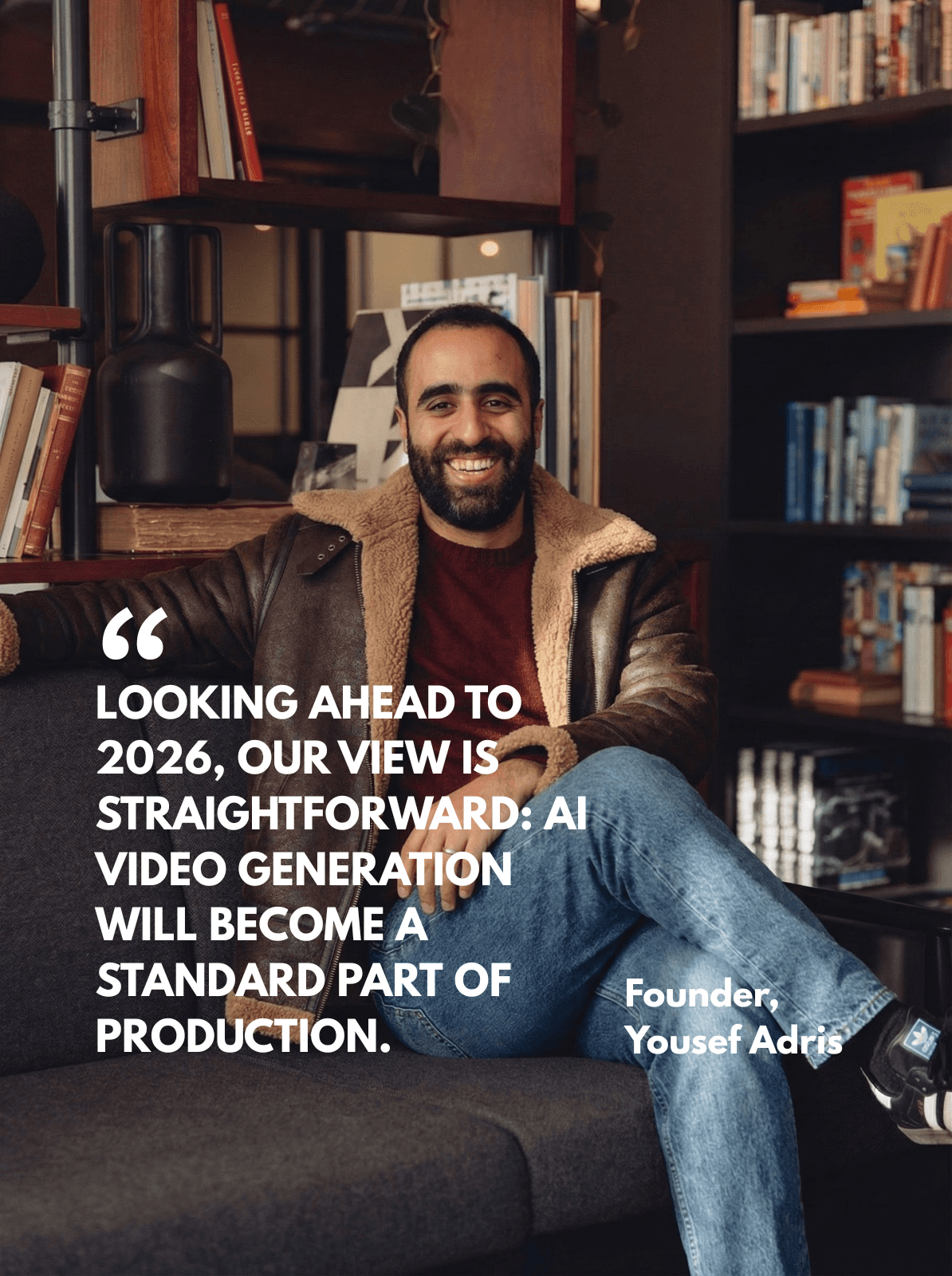
Looking ahead to 2026, our view is straightforward: AI video generation will become a standard part of production. Not because it’s trendy, but because the techniques for achieving realism, continuity, and control are getting easier and more accessible. As that happens, a lot of new players will enter the space. Most of them will still be learning the hard lessons—how to avoid artificiality, how to maintain coherence, how to direct AI instead of letting it dictate outcomes.
By then, our workflows will already be mature. The ads we’ve delivered, the campaigns that performed, and the trust we’ve built with clients will serve as proof—not of technological novelty, but of process knowledge. Knowing how to make AI disappear into craft will be the real differentiator.
At the same time, we’re deliberately investing more time and money into original IP. This year, projects like Kiko & Ziko and Bab El Talsm aren’t side experiments; they’re strategic. Kiko & Ziko allows us to build audience, longevity, and format discipline in children’s content. Bab El Talsm is our first step into adult, high-concept micro-drama—compressed storytelling, symbolic worlds, and strong authorial voice. Together, these projects position Studio Hawa not as a service vendor chasing trends, but as a creative production house rooted in the region’s storytelling tradition, simply using a new set of tools.
The future isn’t AI versus humans. It’s craft versus shortcuts. By 2026, that difference will be impossible to ignore.